Article: What Is a Hand Knotted Rug? The Complete Guide
What Is a Hand Knotted Rug? The Complete Guide
There is a particular kind of quiet that settles over a room with a hand knotted rug on the floor. It is not just the softness underfoot or the depth of colour — it is the accumulated presence of thousands of hours of human attention, tied knot by knot into something that will outlast the furniture around it. If you have ever wondered what a hand knotted rug actually is, why it costs what it does, and how to tell one from an imitation, this guide is for you.

The Technique: How a Hand Knotted Rug Is Made
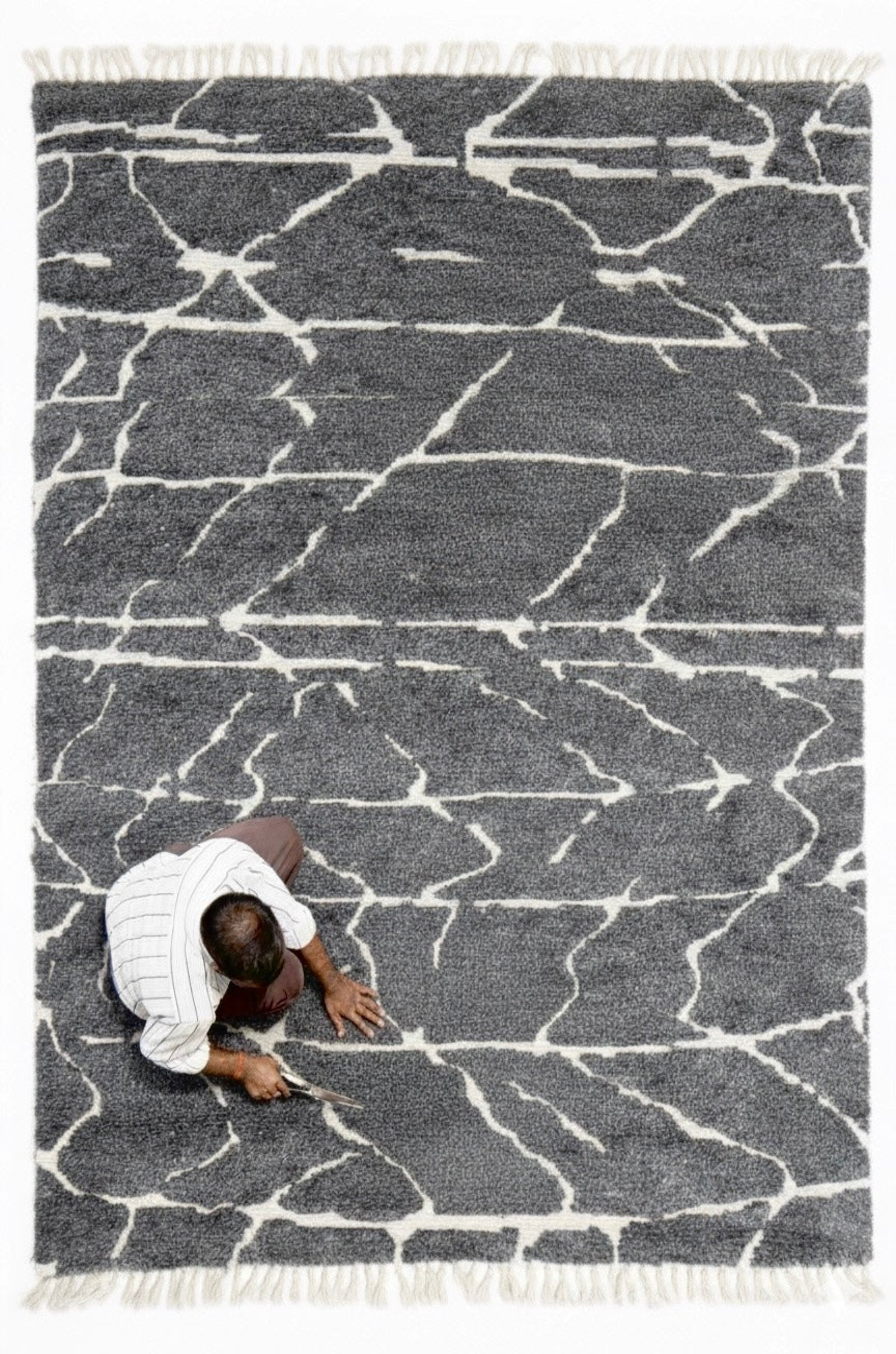
A hand knotted rug begins on a loom strung with vertical threads called the warp. A weaver works horizontal threads — the weft — through these warps to create the foundational structure. Then, row by row, individual strands of wool, silk, or cotton are tied around pairs of warp threads to form the pile. Each of these tied strands is a knot.
Once a row of knots is complete, the weaver passes a weft thread through to lock them in place, trims the pile to an even height, and begins the next row. There are no shortcuts in this process.
Persian (Senneh) vs Turkish (Ghiordes) Knots
The Persian knot — also called the Senneh or asymmetric knot — wraps around one warp thread and loops loosely around the adjacent one. This allows weavers to achieve extremely fine detail and high knot density, making it the technique of choice for intricate floral and curvilinear patterns.
The Turkish knot — also called the Ghiordes or symmetric knot — wraps fully around two adjacent warp threads. It creates a slightly firmer, more robust pile, common in Turkish and Caucasian traditions.
How Long Does It Take?

A medium-sized hand knotted rug might take a single skilled weaver several months. A large rug with high knot density can take a team of weavers the better part of a year. The finest silk rugs can take years.
At House of Rugs, our artisan families in India have been practising this craft since 1951 — now in their fourth generation.
Understanding KPSI
KPSI — knots per square inch — is the standard measure of density and fineness.
- 80–120 KPSI: Good quality, suited to geometric patterns
- 120–200 KPSI: High quality, fine curvilinear and floral work
- 200–400 KPSI: Very fine, typically wool-silk blends
- 400+ KPSI: Exceptional, museum-grade pieces
How to Identify a Hand Knotted Rug
Flip the rug over. On a genuine hand knotted rug, the underside will show the same pattern as the top, with individual knots visible. Other indicators:
- Slight irregularities — the natural product of human hands
- Fringes that are extensions of the warp threads
- Dense, springy pile with visible depth
- Substantial weight compared to machine-made alternatives
Why They Are Worth It
A hand knotted rug is closer to a painting than furniture. The cost reflects genuine rarity — no machine can replicate the process. Unlike most home purchases, a well-made hand knotted rug does not wear out — it wears in. The pile softens, colours deepen, and after decades of use, it is often more beautiful than the day it was laid down.
Why Choose House of Rugs
Founded in 1951, now in our fourth generation, we have spent over seven decades refining every part of the process. Our weavers are not anonymous workers — many are women from communities where this craft has been practised for generations.
Related Reading
- What Is a Hand Tufted Rug? Everything You Need to Know
- What Is a Flatweave Rug? Your Guide to Dhurries and Kilims
- Handloom vs Hand Knotted vs Hand Tufted: Which Rug Is Right for You?
- The Complete Rug Buying Guide for Indian Homes (2026)
Still deciding? Book a free rug consultation with our design team, or browse the full House of Rugs collection.